

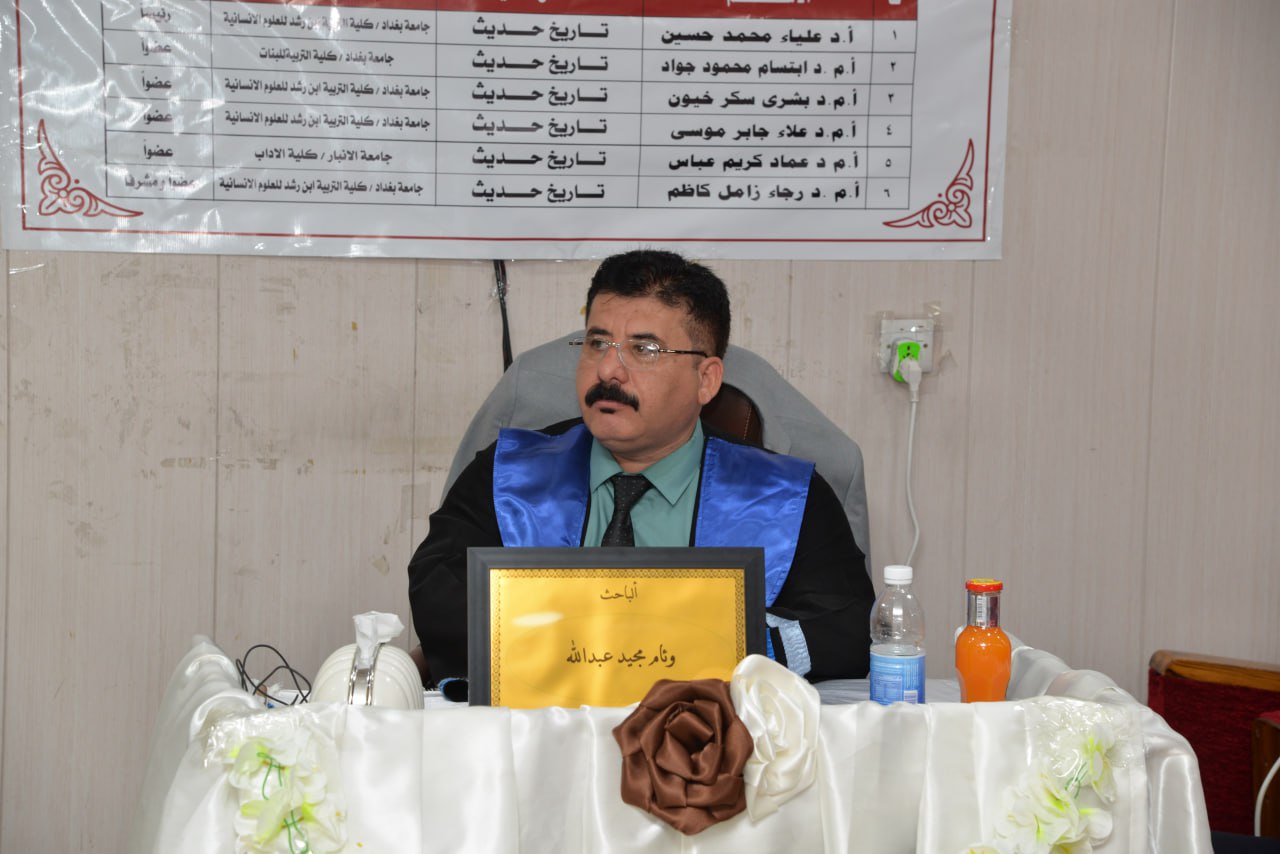
The Ibn Rushd College of Education for Human Sciences, University of Baghdad, discussed a PhD dissertation entitled “United States Policy Toward Bulgaria (1944–1950)”, submitted by researcher Wiam Majid Abdullah from the Department of History, specializing in Modern History.
The examination committee was chaired by Professor Dr. Aliaa Mohammed Hussein, with Assistant Professor Dr. Raja Zamel Kazem serving as member and supervisor, along with a group of faculty members from Ibn Rushd College. The external members included Assistant Professor Dr. Intisar Mahmoud from the College of Education for Women and Assistant Professor Dr. Imad Karim from the College of Arts, University of Anbar.
The study aimed to highlight how the development of modern Bulgaria was influenced by shifts in the balance of power in Europe. The emergence of Bulgaria as an independent nation in 1878 resulted both from the rivalry of great powers seeking control over Europe and from national self-determination movements. This extended from early pro-Soviet sympathies to pro- and anti-Western orientations during the communist period, where foreign policy direction played a decisive role in Bulgaria’s domestic affairs.


